Guides
How it works
Understand how SecureAuth AI Gateway proxies MCP requests
The Model Context Protocol (MCP) is an open standard that allows AI agents to interact with external tools and services. MCP uses a client-server architecture: the AI agent is the MCP client and each service (Slack, Jira, etc.) runs an MCP server that exposes tools.
SecureAuth AI Gateway acts as both an MCP server (to your agents) and an MCP client (to upstream services). Your agents connect to a single gateway endpoint that exposes tools from all configured resources. You can add or remove resources without reconfiguring any agents.
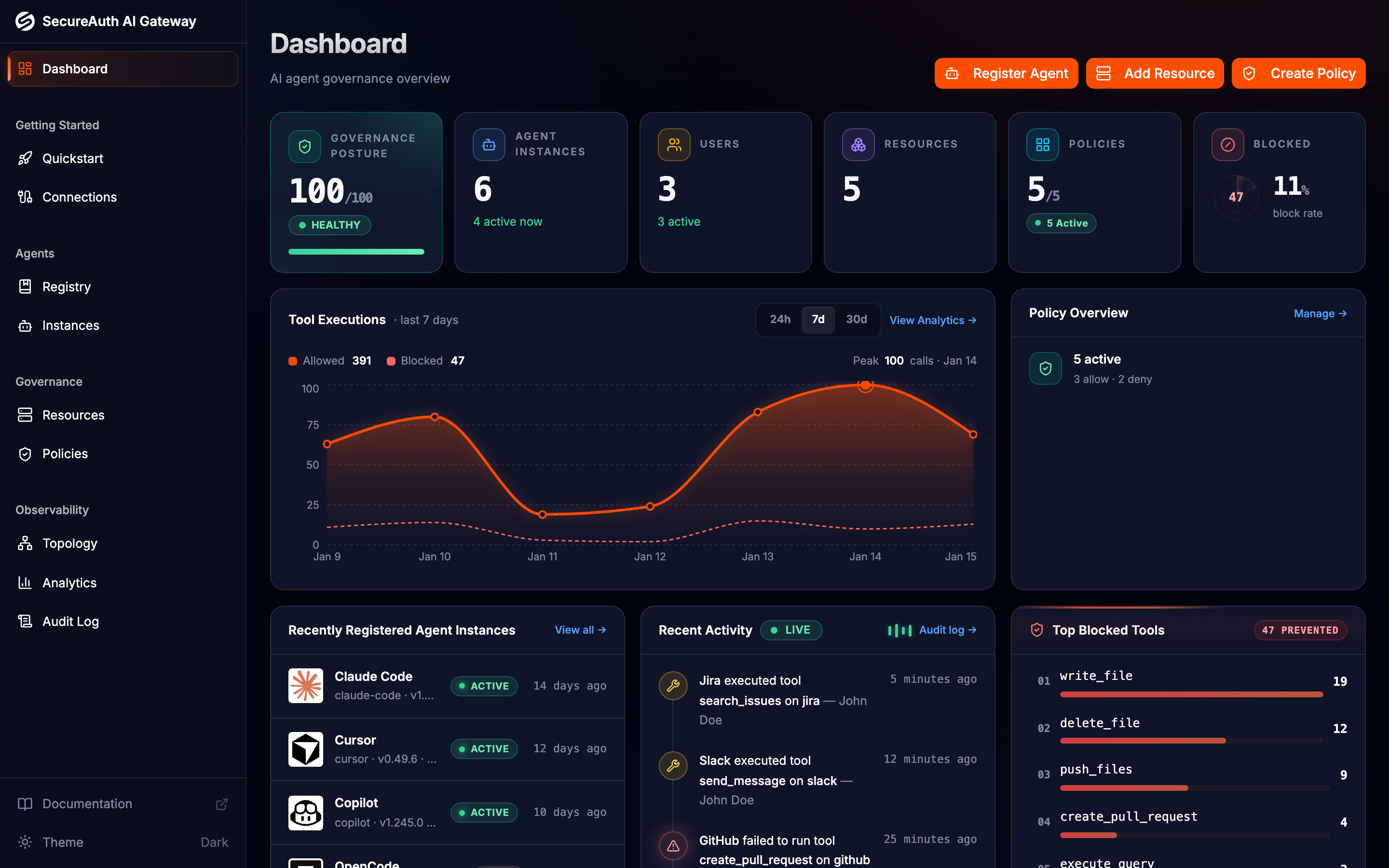
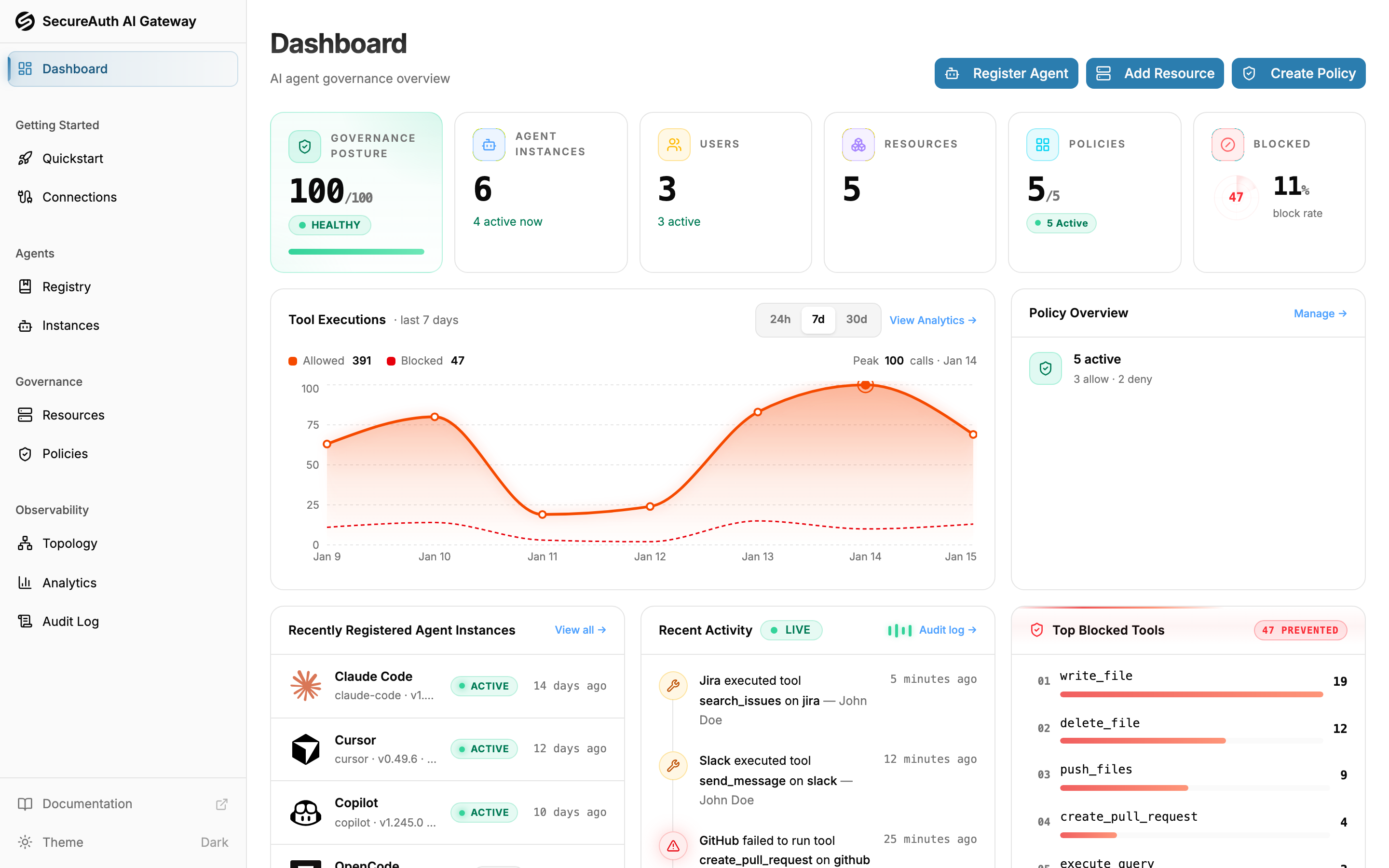
Request flow
- Your AI agent sends an MCP tool call to the gateway
- The gateway authenticates the agent and identifies the user
- Policy rules are evaluated top-to-bottom against the request
- If allowed, the request is forwarded to the upstream MCP server using the user's credentials
- The response is returned to the agent
- The entire interaction is recorded in the audit log
Key benefits
- Single endpoint — Agents only need one MCP configuration, regardless of how many services they access. When an agent enforces a per-connection tool limit, you can instead point it at a single MCP's endpoint to keep its tool list small
- Centralized control — Admins manage all resource access from one dashboard
- Per-user credentials — Each user authenticates to services with their own account
- Full audit trail — Every tool call is logged with user, agent, and request details